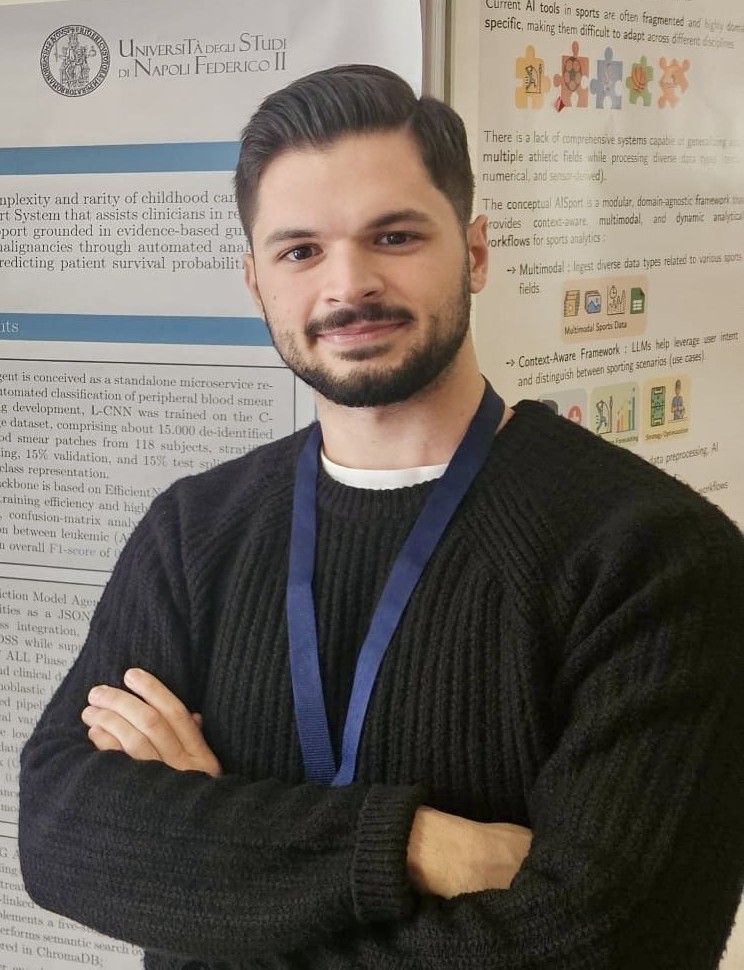
About Me
I hold a B.Sc. in Computer Engineering and an M.Sc. in Computer Science from the University of Naples Federico II, where I am currently a Ph.D. Student in Computational Intelligence.
My Ph.D. research focuses on neurosymbolic and explainable approaches in medicine, aiming to bridge formal reasoning and machine learning for trustworthy AI systems. I am passionate about Computer Vision and Machine Learning, and I am currently deepening my studies in Formal Logics.
I am a member of the ASTREA Lab, supervised by Prof. Aniello Murano, Vice President of AIxIA, EurAI Fellow, and AAIA Fellow.
Selected Publications
Toward Explainable Diagnosis: A Neurosymbolic Approach
Ciro Listone, Vadim Malvone, Aniello Murano
18th International Conference on Agents and Artificial Intelligence, 2026
Article Here
Read Abstract
The growing adoption of Artificial Intelligence (AI) in medicine highlights the limitations of neural models, which often lack transparency and verifiability. This work presents a theoretical formalization of a neurosymbolic game model that integrates an autoencoder with Obstruction Logic (OL) to model the diagnostic process as structured reasoning guided by knowledge and formal constraints. The autoencoder learns relationships among symptoms from data, producing continuous representations that enrich the clinical picture and capture latent structure. These representations serve as input to a logical module based on OL, a dynamic and tractable formalism that progressively eliminates diagnostic hypotheses inconsistent with established medical knowledge. The combined system merges the inferential power of neural networks with the rigor and reliability of symbolic reasoning, offering interpretable, consistent outcomes. This approach aims to enable decision support tools that maintain clinical trustworthiness while leveraging data-driven insights, providing a pathway toward more transparent and verifiable AI-assisted medical diagnostics.
APODSS: An Agentic Pediatric Oncology Decision Support System
Marco Aruta, Ciro Listone, Shilpa Srinivasareddy, Aniello Murano
18th International Conference on Agents and Artificial Intelligence, 2026
Article Here
Read Abstract
Pediatric oncology poses unique diagnostic and prognostic challenges due to the complexity and rarity of childhood cancers. To address these, we propose APODSS, an Agentic Pediatric Oncology Decision Support System that assists clinicians in real-time, data-driven decision-making. APODSS integrates three specialized agents: a convolutional neural network (L-CNN) for leukemia image classification, a Cox Proportional Hazards model for survival prediction, and a Retrieval-Augmented Generation (RAG) Large Language Model (LLM)forcontext-aware reasoning. These agents are orchestrated via LangGraph, enabling transparent, trace able, and extensible workflows. The system achieves strong performance, with an F1-score of 0.97 for image classification and a C-index of 0.742 for survival prediction. The LLM agent operates locally via Ollama, grounded in semantically retrieved clinical guidelines from ChromaDB. Evaluation highlights APODSS’s ability to deliver low-latency inference and interpretable outputs across modalities. Future developments aim to broaden diagnostic coverage, incorporate real-world data, and enhance personalization.
An Innovative Infrastructure for a Pediatric Oncology Network in the Campania Region
Erica Ambrosino, Marco Aruta, Dalia As Ad, Sara Ferrigno, Ciro Listone, Floriana Nappi, Salvatore Romano, Melania Ruopolo, Francesco Adinolfi, Michele Cimmino, Mariapia Raimondo, Francesco Serino and Aniello Murano
19th International Joint Conference on Biomedical Engineering Systems and Technologies (Healthinf), 2026
Article Here
Read Abstract
Progress in medical research has greatly improved survival among children with oncohematological diseases. Yet, for pediatric patients with leukemia or solid tumors, treatment remains long, complex, and emotionally demanding. Therapies often last years, requiring constant monitoring, frequent hospital visits, and intensive care. Geographic disparities add further challenges. Specialized oncology centers are concentrated in large cities, forcing families from smaller towns or rural areas to travel long distances. These repeated transfers generate financial strain, organizational difficulties, and emotional stress, negatively affecting adherence and outcomes. Moreover, communication between hospitals and local health services is often fragmented, creating gaps in continuity of care. The INFANT project, developed in Campania, Italy, was created to address these issues through a hub-and-spoke model. In this system, main hospitals collaborate with local facilities to deliver high-quality standardized care closer to patients’ homes. Supported by interoperable digital platforms and artificial intelligence, INFANT promotes earlier diagnosis, personalized treatments, and improved monitoring. The program also integrates educational and psychological support, fostering a holistic approach to pediatric oncology. By reducing inequalities and strengthening care pathways, the project seeks to ensure sustainable, equitable, and patient-centered treatment for children and their families.
ADNF-Clustering: An Adaptive and Dynamic Neuro-Fuzzy Clustering for Leukemia Prediction
Marco Aruta, Ciro Listone, Giuseppe Murano, Aniello Murano
IEEE International Conference on E-health Networking, Application & Services (Healthcom), 2025
Article Here
Read Abstract
Leukemia diagnosis and monitoring rely increasingly on high-throughput image data, yet conventional clustering methods lack the flexibility to accommodate evolving cellular patterns and quantify uncertainty in real time. We introduce Adaptive and Dynamic Neuro–Fuzzy Clustering, a novel streaming-capable framework that marries Convolutional Neural Network based feature extraction with an online fuzzy clustering engine. ADNF initializes soft partitions via Fuzzy C-Means, then continuously updates micro-cluster centers, densities, and fuzziness parameters using a Fuzzy Temporal Index (FTI) that measures entropy evolution. A topology-refinement stage per-forms density-weighted merging and entropy-guided splitting to guard against over (and under) segmentation. On the C-NMC leukemia microscopy dataset, our tool achieves a silhouette score of 0.51, demonstrating superior cohesion and separation over static baselines. The method’s adaptive uncertainty modeling and label-free operation hold immediate potential for integration within the INFANT pediatric oncology network, enabling scalable, up-to-date support for personalized leukemia management.
Bone Segmentation in Low-Field Knee MRI Using a Three-Dimensional Convolutional Neural Network
Ciro Listone, Diego Romano, Marco Lapegna
Big Data and Cognitive Computing, 2025
Article Here
Read Abstract
Bone segmentation in magnetic resonance imaging (MRI) is crucial for clinical and research applications, including diagnosis, surgical planning, and treatment monitoring. However, it remains challenging due to anatomical variability and complex bone morphology. Manual segmentation is time-consuming and operator-dependent, fostering interest in automated methods. This study proposes an automated segmentation method based on a 3D U-Net convolutional neural network to segment the femur, tibia, and patella from low-field MRI scans. Low-field MRI offers advantages in cost, patient comfort, and accessibility but presents challenges related to lower signal quality. Our method achieved a Dice Similarity Coefficient (DSC) of 0.9838, Intersection over Union (IoU) of 0.9682, and Average Hausdorff Distance (AHD) of 0.0223, with an inference time of approximately 3.96 s per volume on a GPU. Although post-processing had minimal impact on metrics, it significantly enhanced the visual smoothness of bone surfaces, which is crucial for clinical use. The final segmentations enabled the creation of clean, 3D-printable bone models, beneficial for preoperative planning. These results demonstrate that the model achieves accurate segmentation with a high degree of overlap compared to manually segmented reference data. This accuracy results from meticulous fine-tuning of the network, along with the application of advanced data augmentation and post-processing techniques.